☰ Table of Contents
- Why Startup HR Services Matter as Teams Grow
- Build Employee Onboarding for Startups Around the Employee Experience
- Turn HR Policies into Practical Operating Guidelines
- Connect HR Systems, Compliance and Employee Lifecycle Processes
- From Reactive HR to a Scalable Workforce Function
- Frequently Asked Questions

For a growing startup, hiring can feel like a race against the clock. Founders need people quickly, managers need roles filled, and candidates expect a smooth experience. But as headcount grows, informal HR practices can become difficult to manage. This is where startup HR services can help transform scattered activities into structured, scalable processes that support both people and business growth.
The goal is not to make a startup bureaucratic. It is to create enough structure to make decisions faster, reduce risk and give employees clarity.
Why Startup HR Services Matter as Teams Grow
In the early stages, HR oftaen happens around everything else. A founder may approve leave over a message, maintain employee information in a spreadsheet and handle onboarding between client meetings. It works — until it does not.
As a startup moves from a small founding team to a larger workforce, these informal systems begin creating friction. Hiring decisions become inconsistent, documentation gets missed, managers interpret processes differently and employee queries consume leadership time.
In this scenario, HR for startup companies needs to be approached as an operating system rather than an administrative function. A scalable HR foundation typically brings together clearly defined processes for recruitment, documentation, payroll, employee records, compliance, performance and exits. The objective is simple: establish a consistent way of managing people without taking away the agility that makes startups successful.
Start with a Structured Hiring Framework
A fast-growing company needs more than just hiring. It needs a repeatable startup hiring process.
Consider a technology startup expanding into a new product vertical. Initially, hiring may be driven by urgent business requirements. As recruitment volumes increase, however, different managers may use different interview criteria, approval processes and candidate communications. The result can be slower hiring and an inconsistent candidate experience.
A structured framework can define who owns each stage, from workforce planning and job descriptions to interview evaluation, offer documentation and background verification. This makes recruitment easier to track and provides a stronger foundation for future growth.
The same principle applies across industries. Whether a startup is hiring engineers, sales professionals, healthtech specialists, operations staff or finance teams, clarity in recruitment creates consistency.
Build Employee Onboarding for Startups Around the Employee Experience
Getting someone to accept an offer is only one part of hiring. What happens after acceptance can influence how quickly a new employee becomes productive and how they perceive the organisation.
Effective employee onboarding for startups should answer practical questions before they become problems. Who does the employee report to? What are the expectations for the role? Which policies apply? How are leave and attendance managed? What systems and tools should they access? When should their first performance conversation happen?
Imagine a growing e-commerce company onboarding several employees across operations, technology and customer support. Without a defined process, each person may receive different information and have a different first-week experience. A standardised onboarding framework can bring consistency while still allowing individual teams to personalise the experience.
Good onboarding is therefore more than a checklist. It connects documentation, culture, role clarity and early performance expectations.
Turn HR Policies into Practical Operating Guidelines
As organisations grow, verbal understandings eventually stop being enough. Employees need clarity, and managers need consistent guidance.
Here, HR policy development becomes vital. Startups should prioritise policies that reflect their workforce, operating model and applicable Indian employment requirements rather than copying generic templates.
Policies covering leave, working arrangements, workplace conduct, POSH, attendance, expenses and other relevant areas can establish clear expectations. More importantly, policies should be communicated and implemented consistently.
For HR for startup companies, removing ambiguity from recurring decisions is more important than just creating a thick, generic employee handbook. A policy is valuable when a manager knows how to apply it, an employee knows what to expect and the business can demonstrate that decisions are being handled fairly and consistently.
Connect HR Systems, Compliance and Employee Lifecycle Processes
HR structure becomes significantly more effective when individual processes work together.
For example, an employee joins the organisation, their documents are collected, their details are recorded in the HRMS, payroll inputs are captured, statutory requirements are addressed and onboarding activities are completed. Later, the same employee moves through performance reviews, leave management, development and eventually exit processes.
When these activities operate independently, information can become fragmented. When they are connected, the organisation gains greater visibility and fewer manual handovers. Employee onboarding for startups is therefore not an isolated HR task. It is the first stage of a broader employee lifecycle.
Technology can support this transition by centralising employee information, automating routine workflows and providing leadership with better visibility. However, software alone does not solve an HR problem. Startups need well-defined processes first, followed by systems that support those processes.
Scale the Structure, Not the Bureaucracy
The best HR framework for a startup is not necessarily the most complex one. It is the one that can evolve.
A ten-person business may need basic documentation, payroll, compliance and onboarding processes. A company with 100 or 500 employees may require more sophisticated performance frameworks, workforce planning, HR technology and manager enablement.
The underlying principle remains the same: build processes before complexity makes them unavoidable.
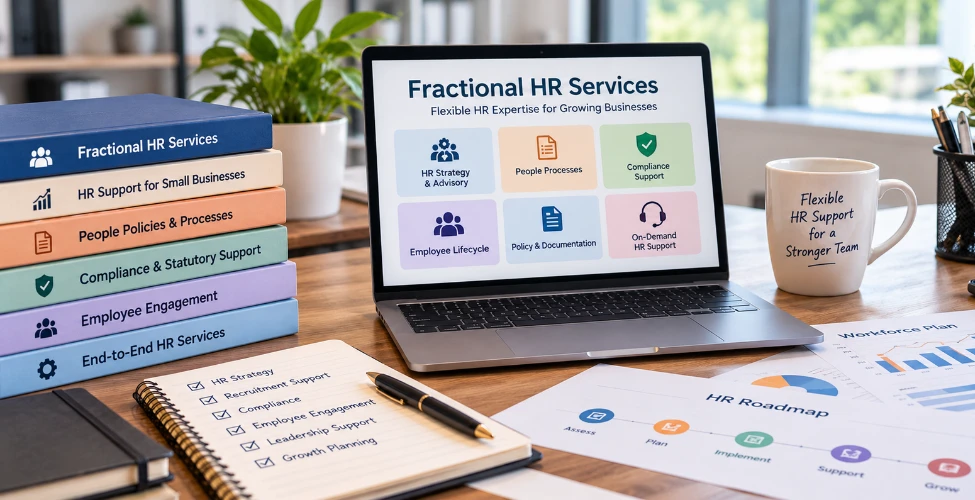
This is where startup HR services can provide practical value. An experienced HR partner can help identify gaps, establish processes, manage operational requirements and advise leadership without requiring the business to immediately build a large internal HR function.
For founders, this creates something more valuable than administrative support: confidence that the people side of the business can keep pace with growth.
From Reactive HR to a Scalable Workforce Function
Startup growth naturally brings uncertainty. New hires, changing roles, new locations, evolving teams and shifting business priorities are part of the journey. HR cannot eliminate that uncertainty, but it can create a structure within which the organisation can respond effectively.
The right startup HR services help move HR from reactive problem-solving towards proactive people management. They bring consistency to hiring, clarity to employee processes, confidence around compliance and a better experience for employees and managers.
For startups in India, building this foundation early can prevent HR from becoming another source of operational complexity as the business grows. Vachi HR helps growing organisations build structured, compliant and scalable people systems across the employee lifecycle. If your startup is hiring rapidly, formalising HR or preparing for its next stage of growth, speak to Vachi HR to build an HR framework designed to grow with your business.
Frequently Asked Questions
1. When should a startup start building formal HR processes?
Ideally, before rapid growth makes informal processes difficult to manage. Even a small team benefits from clear hiring, onboarding, documentation, payroll and compliance processes.
2. Can startups outsource HR instead of building an internal team?
Yes. Startups can use external HR expertise for specific functions or broader ongoing support, depending on their size, needs and stage of growth.
3. What should employee onboarding include?
It should cover documentation, role expectations, policies, access to systems, reporting relationships, team integration and early performance expectations.
4. How can HR processes scale with a growing startup?
Processes should be designed with clear ownership, documented workflows and appropriate technology. They can then be expanded as headcount, locations and organisational complexity increase.
5. How can Vachi HR support a growing startup?
Vachi HR provides HR consulting, compliance support, payroll, employee lifecycle management, HR systems and workforce solutions designed to help growing organisations establish reliable and scalable HR foundations.