Lean organisations are built for agility. They keep teams focused, minimise unnecessary overheads and enable decisions to be made quickly. But as a business grows, the same lean structure can expose gaps in people management, compliance, employee processes and leadership support. Fractional HR services can provide a practical way to address those gaps without immediately committing to a full-time HR department.
7 Ways Fractional HR Services Can Bridge the Gaps
1. Bring HR Expertise Without Adding Permanent Overhead
One of the biggest advantages of a flexible HR model is access to experienced expertise without immediately creating another full-time position. For a growing business, the requirement for HR expertise may not justify a permanent senior HR hire. There may be periods when strategic input is essential, followed by quieter periods where only operational support is needed.
This is where part-time HR services can offer a more proportionate solution. Businesses can access professional guidance according to their stage, priorities and workload rather than paying for capacity they may not consistently need.
2. Turn Reactive HR Into Structured HR
In lean businesses, HR frequently begins with a simple approach: deal with issues as they arise. That might work when there are only a handful of employees. As headcount increases, however, informal approaches can create inconsistency. Different managers may handle similar situations differently, documentation may be incomplete and employees may receive unclear messages.
External HR expertise can introduce structure through clearly defined processes, policies, documentation and responsibilities. For leaders looking for HR support for small businesses, this can be particularly valuable because it creates a foundation before complexity becomes difficult to manage.
3. Strengthen Compliance Before It Becomes a Problem
HR compliance is an area where lean organisations cannot afford to rely solely on good intentions. Employment regulations, statutory requirements, documentation, payroll processes and employee records all require appropriate attention.
A specialist HR partner can review existing practices, identify areas of exposure and establish processes that are easier for managers to follow. This proactive approach is important because effective HR is all about reducing the likelihood and impact of problems occurring in the first place.
4. Give Managers a Trusted Sounding Board
Managers in lean organisations often become responsible for people matters without having formal HR expertise. They may need to manage underperformance, handle difficult conversations, respond to employee concerns or make decisions around workplace policies.
Access to experienced HR guidance gives managers a place to test decisions, understand risks and approach sensitive conversations more confidently. In practice, this can be one of the most valuable forms of part-time HR services: not simply completing administrative tasks, but providing informed judgement when leaders need it.
5. Build Employee Processes That Can Scale
What works for a 15-person company may not work for a 100-person organisation. As headcount increases, informal onboarding, inconsistent performance reviews and undocumented processes can create friction for employees and managers alike.
A scalable HR framework might include:
- Consistent recruitment and onboarding processes
- Clear employee documentation and policies
- Defined performance management cycles
- Structured feedback and development conversations
- Reliable payroll and employee records
- Appropriate HR systems and reporting
- Clear processes for employee exits
These foundations allow the business to grow without constantly reinventing how people-related matters are handled.
6. Help Founders Focus on the Business, Not Every HR Issue
For founders and senior leaders, time is one of the organisation’s most valuable resources. When HR administration, employee queries and people-related decisions repeatedly land on the leadership team, strategic priorities can suffer. Leaders may find themselves spending time solving issues that could have been prevented through better processes or handled by an experienced HR professional.
This is where HR support for small businesses can make a meaningful difference. The aim is to give them the structure, information and professional support needed to make decisions effectively. A good HR partner becomes an extension of the leadership team, helping translate business priorities into practical people practices.
7. Create a Pathway Towards Long-term HR Maturity
Fractional support does not have to be a permanent alternative to an internal HR function. For some organisations, it can be a bridge between having no dedicated HR capability and eventually building an in-house team. During that transition, an external partner can establish policies, processes, systems and reporting frameworks that make future internalisation easier.
For others, an external model may remain the most efficient option because their HR requirements fluctuate or because they prefer to keep their core team lean. The right model depends on the organisation’s size, growth plans, complexity and internal capability.
When Should a Lean Organisation Consider External HR Support?
There is no universal headcount at which a business suddenly needs HR expertise. A more useful question is whether the complexity of the organisation has outgrown its current people processes. Some signs include:
- Leaders are spending increasing amounts of time on employee matters.
- HR decisions are being made inconsistently.
- Policies and documentation are outdated or incomplete.
- Managers lack confidence handling employee issues.
- Recruitment is increasing but onboarding remains informal.
- Performance management happens only when problems arise.
- Compliance questions are becoming more frequent.
- Employee data is spread across disconnected systems.
- Leadership wants better workforce visibility before making growth decisions.
At this stage, engaging an HR consultant for small business can help identify the most important gaps and prioritise improvements rather than introducing unnecessary processes.
What Should a Flexible HR Partnership Cover?
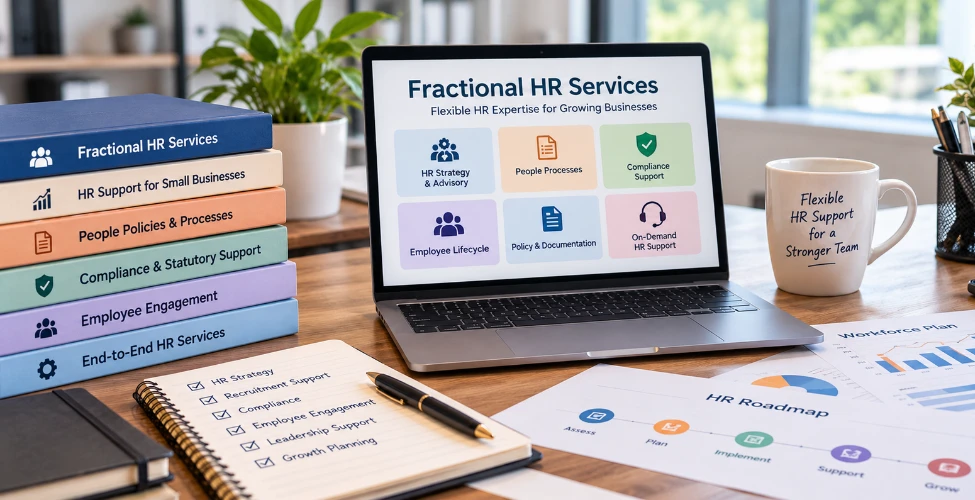
Depending on business requirements, support can cover HR audits, policies and SOPs, compliance, payroll coordination, employee lifecycle processes, performance management, workforce planning, HR systems, employee engagement and leadership development.
For organisations that need broader support, end-to-end HR services can create greater consistency because the different parts of the employee journey are connected rather than managed in isolation. The important principle is flexibility. A lean organisation should be able to access the right expertise at the right time without creating unnecessary organisational complexity.
Conclusion: Build the HR Capability Your Business Actually Needs
Lean organisations do not need to choose between having no HR structure and building a large internal HR department. A flexible model can provide access to expertise, strengthen processes and give leaders confidence while allowing the business to remain agile.
If your organisation is growing faster than its HR processes, Vachi HR can help you assess where the gaps are and determine what level of support makes sense for your business. Get in touch with Vachi HR to build a stronger, more structured and growth-ready people function.
Frequently Asked Questions
1. What are Fractional HR services?
They provide businesses with access to professional HR expertise on a flexible basis rather than requiring a full-time HR hire. The scope can range from strategic advice and compliance to employee processes and ongoing HR operations.
2. Are flexible HR solutions suitable for small businesses?
Yes. Smaller organisations often need HR expertise but may not require a full-time senior HR professional. A flexible arrangement can provide the right level of support as the organisation’s needs evolve.
3. How do part-time HR services differ from hiring an HR employee?
The key difference is flexibility. External support can provide access to broader experience and expertise without the fixed commitment of a permanent role. The arrangement can also be scaled according to business priorities.
4. Can external HR support help with compliance?
Yes. An experienced HR partner can review processes, identify potential gaps, support policy development and help organisations maintain more consistent HR and statutory practices.
5. When should a growing organisation consider external HR support?
There is no single headcount threshold. It is worth considering when HR responsibilities are taking significant leadership time, processes are becoming inconsistent, compliance is creating uncertainty or the organisation is preparing for growth.
6. What is the difference between fractional HR and outsourced HR?
Fractional HR provides flexible, part-time HR expertise and strategic support, while outsourced HR typically involves handing over specific HR functions or operations to an external provider.