☰ Table of Contents
- The Misconception: HR as a Soft Function
- Defining ROI in HR: What Should You Measure?
- Scenario: Measuring ROI in a Growing Organisation
- Linking HR Metrics to Business Metrics
- The Role of Technology in Measuring ROI
- Moving from Activity to Impact
- Building an ROI-Driven HR Framework
- Why Leaders Are Re-Evaluating HR Investment
- Vachi HR: Turning People into Performance
- Final Thoughts
- FAQs
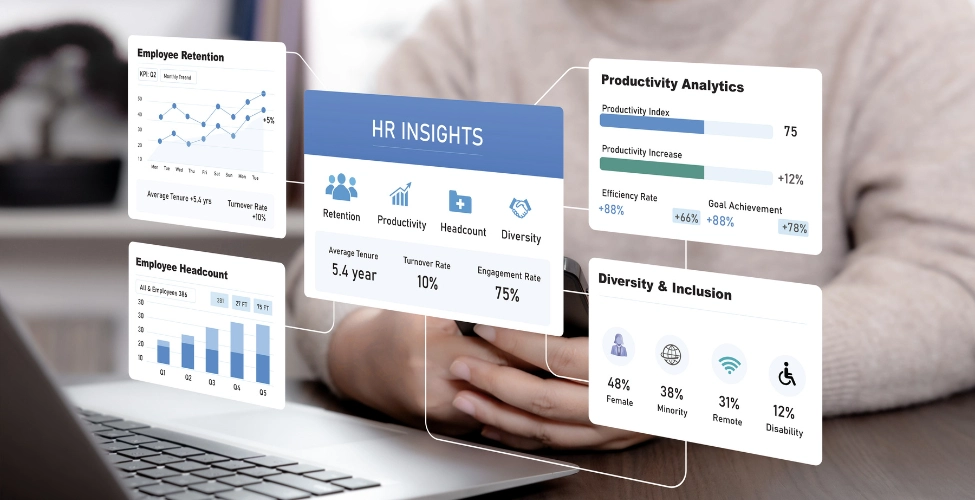
For many organisations, HR still sits in a grey zone, where it is essential, yet difficult to quantify. Budgets are approved, initiatives are rolled out, but when leadership asks a simple question about the return on this investment, the answers often lack clarity.
This is where the conversation must shift. Good HR is not a cost centre. When designed well, it becomes a measurable driver of business performance. The real challenge lies not in proving HR’s value, but in knowing where and how to look for it.
The Misconception: HR as a Soft Function
Corporate leaders often associate HR outcomes with intangible elements: engagement, culture, and satisfaction. These are important, but they rarely translate directly into boardroom metrics unless intentionally linked.
Consider a mid-sized company scaling rapidly. Hiring is aggressive, but onboarding is inconsistent. Within six months, attrition spikes. Recruitment costs rise. Team productivity dips. Leadership may attribute this to “market conditions,” when in reality, the absence of structured employee lifecycle management services is quietly eroding margins.
HR, in this scenario, is not underperforming; it is under-measured.
Defining ROI in HR: What Should You Measure?
ROI in HR is best understood as the impact of people decisions on business outcomes. This requires shifting focus from activities to results. A structured approach typically connects HR initiatives to four measurable areas:
1. Productivity Gains
When roles are clearly defined, onboarding is structured, and performance systems are aligned, employees reach productivity faster. Time-to-productivity becomes a critical metric.
2. Cost Optimisation
Effective workforce planning services ensure the right talent is hired at the right time. Over-hiring, underutilisation, and high attrition all carry hidden costs that good HR eliminates.
3. Risk Reduction
Compliance failures, payroll errors, and policy gaps can lead to financial and reputational damage. Strong HR advisory services mitigate these risks before they surface.
4. Revenue Impact
Engaged, well-trained teams contribute directly to customer satisfaction, innovation, and sales performance. The connection may not always be immediate, but it is measurable over time.
Scenario: Measuring ROI in a Growing Organisation
Imagine a technology company expanding from 50 to 200 employees within a year.
Without structured HR:
- Hiring decisions are reactive
- Offer rollouts are inconsistent
- Managers define performance expectations independently
Within months:
- High performers leave due to unclear growth paths
- Salary disparities create internal friction
- Leadership spends increasing time resolving people issues
Now, introduce structured HR solutions for businesses:
- A defined hiring framework aligned with business goals
- Standardised onboarding processes
- Performance metrics tied to organisational outcomes
- Transparent compensation structures
The result is not just smoother operations. It is measurable:
- Reduced attrition
- Faster onboarding cycles
- Improved team output
The ROI is visible in both cost savings and performance gains.
Linking HR Metrics to Business Metrics
One of the most effective ways to measure HR ROI is to align HR metrics with financial indicators that leaders already track. For instance:
- Attrition rate → Recruitment and training costs
- Employee engagement → Customer retention and satisfaction
- Time-to-hire → Revenue opportunity loss
- Absenteeism → Operational efficiency
This alignment transforms HR conversations from operational updates into strategic discussions.
Instead of reporting, “engagement scores improved,” the narrative becomes, “improved engagement reduced attrition, saving X in hiring costs and stabilising delivery timelines.”
The Role of Technology in Measuring ROI
Modern HR functions are increasingly supported by technology, not just for automation but for visibility. Dashboards, analytics, and reporting tools enable leaders to:
- Track hiring efficiency in real time
- Monitor payroll accuracy and compliance
- Analyse performance trends across teams
- Identify early warning signs of disengagement
The value of technology lies not in data collection, but in decision-making. When HR systems provide actionable insights, leaders can intervene early, optimise resources, and strengthen outcomes.
Moving from Activity to Impact
A common pitfall in HR measurement is focusing on activity levels:
- Number of trainings conducted
- Policies implemented
- Surveys completed
These are outputs, not outcomes. Impact-focused HR asks different questions:
- Did training improve performance metrics?
- Did new policies reduce compliance risks?
- Did engagement initiatives lower attrition?
This shift requires intentional design. HR processes must be built with measurement in mind from the start.
Building an ROI-Driven HR Framework
To consistently measure HR ROI, organisations need a structured approach:
- Clarity of Objectives: Every HR initiative should tie back to a business goal, such as growth, efficiency, retention, or compliance.
- Defined Metrics: Quantifiable indicators must be established before implementation, not after.
- Integrated Systems: HR, finance, and operations data should connect, allowing for cross-functional insights.
- Continuous Evaluation: HR ROI is not a one-time calculation. It evolves as the organisation grows.
Why Leaders Are Re-Evaluating HR Investment
In today’s business environment, uncertainty is constant: market shifts, talent shortages, and regulatory changes. Leaders are under pressure to do more with less, while maintaining performance and culture. This is precisely where strong HR creates differentiation.
A well-structured HR function:
- Reduces operational noise
- Enables faster decision-making
- Strengthens organisational resilience
- Aligns people efforts with strategic priorities
The return is not limited to financial gains. It includes stability, scalability, and confidence in execution.
Vachi HR: Turning People into Performance
At Vachi HR, our philosophy is simple: when HR is built with intention, it becomes a growth engine. This means:
- Designing HR systems that scale with the business
- Embedding compliance seamlessly into operations
- Creating clarity across the employee journey
- Using data to guide leadership decisions
The focus is not just on delivering processes, but on ensuring those processes drive measurable outcomes. When HR is aligned with business strategy, the question is no longer whether it delivers ROI; it becomes evident in everyday performance.
Final Thoughts
Measuring the ROI of HR is not about justifying its existence. It is about unlocking its full potential. When organisations invest in structured, people-first HR, they gain more than efficiency. They gain a competitive advantage rooted in clarity, capability, and culture; and in a world where people drive performance, that advantage is essential.
FAQs
1. How can HR solutions for businesses demonstrate ROI?
By linking HR metrics such as attrition, hiring efficiency, and productivity directly to financial outcomes like cost savings and revenue growth.
2. What role do workforce planning services play in ROI?
They ensure optimal hiring and resource allocation, reducing unnecessary costs and improving operational efficiency.
3. Are HR advisory services measurable in impact?
Yes, they reduce compliance risks, improve policy effectiveness, and support better decision-making, all of which have financial implications.
4. How do employee lifecycle management services affect business outcomes?
They create consistency across hiring, onboarding, development, and exit, leading to better retention and productivity.
5. Why is measuring HR ROI important for corporate leaders?
It helps leaders make informed investment decisions, align HR with business strategy, and maximise the value of their workforce.